AI Lead Generation for Real Estate Investors With Verified Motivated Seller Data
Real estate investors rarely lose deals because they lack ambition. They lose them because the machine behind the ambition breaks down. A lead comes in from a text campaign, a cold call list, a PPC page, or a referral. Nobody answers fast enough. A rep forgets to follow up. The owner replies at 8:17 p.m. And gets silence until morning. By then, the seller has already spoken with two other buyers.
That is why the conversation around AI for real estate investors has shifted from novelty to operations. Investors are not looking for abstract intelligence. They want fewer missed opportunities, cleaner lead management, better seller lead follow up, and a real estate follow up system that works after hours, on weekends, and during the messy middle when a prospect goes quiet.
For teams focused on motivated seller leads, verified data matters just as much as the follow up itself. Bad records waste budget. Weak contact data burns outbound channels. Sloppy texting hurts deliverability. And unstructured lead handling turns even a strong list into dead air. The investors who consistently convert off market property leads usually get three things right: they start with usable property data, they move quickly, and they keep following up long after competitors stop.
Why verified motivated seller data changes the economics
Every acquisition team has felt the drag of poor list quality. You pull a list that looks good on paper, skip trace it, launch real estate SMS marketing, then watch response rates fall apart because the numbers are wrong, the owners are uninterested, or the records were stale before you ever touched them.
Verified motivated seller data does not eliminate waste, but it can compress the distance between prospecting and real conversations. That matters because the economics of real estate lead generation are unforgiving. If you spend money on list stacking, property owner lookup, skip tracing for real estate investors, and outbound labor, every layer of inaccuracy compounds. A low quality list does not just cost you one campaign. It increases the cost of dialing, texting, and follow up across the entire sales pipeline.
Investors often talk about volume as if it solves everything. It does not. A big list with poor contact quality creates the illusion of scale while lowering the quality of seller conversations. A smaller pool of better records can outperform a much larger dataset if the team can reach owners reliably and qualify them quickly. In practice, that is where real estate investor software earns its keep. Not by generating hype, but by reducing friction between data, outreach, and lead qualification.
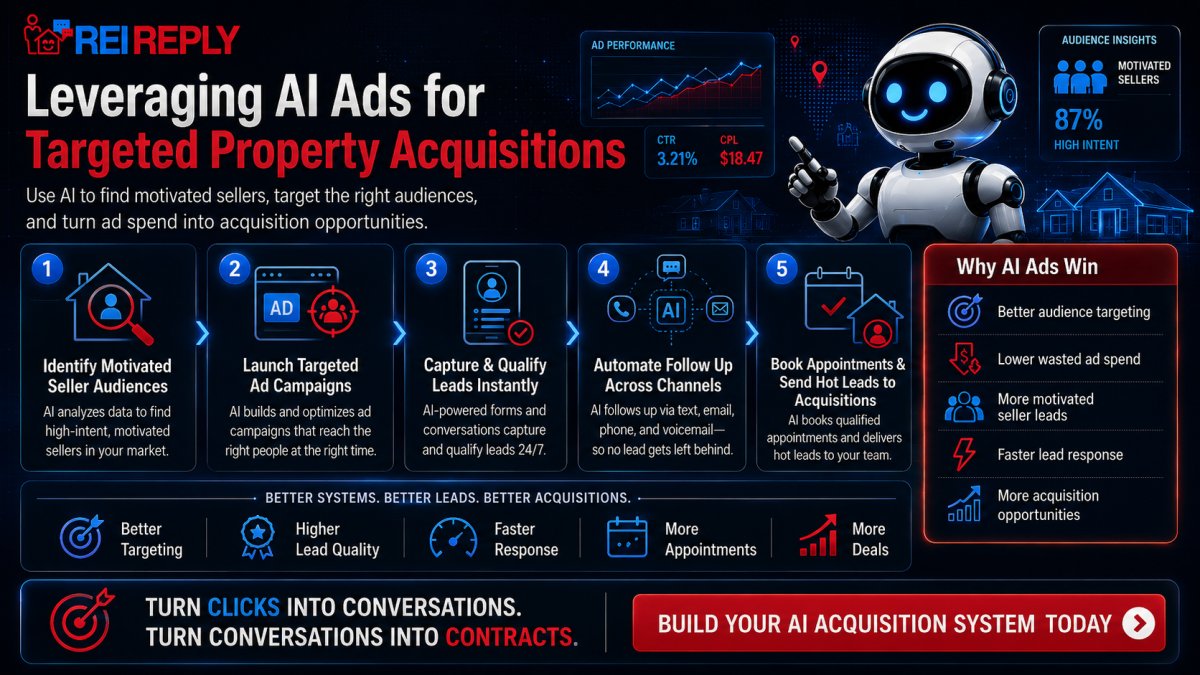
REI Reply is positioned around that operational gap. It describes itself as a real estate investor CRM and follow up system built specifically for real estate investors, with calling, SMS, missed call text back, and AI voice assistants in one platform. It also states that a subscription includes access to verified motivated seller data through REI AI Leads. At the same time, it says it is not a lead provider in the traditional sense, but a conversion engine for leads already being generated. That distinction is important. Serious investors know that lead generation and lead conversion are related, but they are not the same function.
A business can have motivated seller data and still fail because it lacks a disciplined real estate lead follow up process. It can also have a solid follow up engine and still struggle if the lead data is weak. The strongest systems close the gap between the two.
What investors actually need from AI lead generation real estate systems
Most acquisition teams do not need a magical black box. They need software that removes repetitive work without stripping out judgment. The best use of AI real estate investing tools is not to replace the acquisitions manager. It is to handle the first layer of speed, consistency, and screening so the human team can spend more time on negotiations and less time chasing cold records.
That usually starts with response time. When a seller raises a hand, even modestly, the first few minutes matter. If someone calls your marketing number and misses the team, missed call text back can preserve the opportunity. If someone responds to a campaign at night, automated SMS can keep the conversation alive. If inbound volume spikes, a voice AI for real estate investors can help qualify leads, ask simple questions, and book appointments. Those are not glamorous functions, but they are the difference between pipeline growth and pipeline leakage.
REI Reply markets those exact operating functions. Its platform says it supports inbound and outbound calling, SMS, missed call text back, and AI voice agents. It also advertises that its AI voice agent can qualify leads, book appointments, and follow up around the clock across calls, SMS, email, and socials. For a wholesaler or acquisitions team juggling PPC, SEO, cold calling, and text campaigns, that matters more than another dashboard. The practical question is whether your follow up system can keep conversations moving when your staff cannot.
The phrase real estate automation gets abused because people use it to describe everything from a drip campaign to a full investor CRM. In the trenches, automation is more specific. It means the system remembers what the team forgets. It sends the next message. It assigns the callback. It keeps notes attached to the lead. It helps separate curiosity from urgency. Most importantly, it makes sure a lead does not vanish just because nobody was available at the right moment.
The real bottleneck is usually follow up, not lead count
Investors often think they need more seller leads. Sometimes they do. But in many cases, the bigger issue is that the business does not have a reliable seller lead automation process.
A common pattern looks like this. A company runs several channels at once: real estate investor texting, inbound web forms, direct mail callbacks, and cold calling. Responses come in unevenly. The hot leads get attention. The slow burn opportunities, which often become real deals two or three months later, get sporadic contact. The CRM fills with half finished notes, duplicate records, and vague statuses like “call back later.” Eventually the team says lead quality is bad, when the real problem is that lead nurturing real estate systems were never built properly.
AI lead follow up can help most in that middle zone. Not every seller is ready now. Some are testing the waters, waiting on probate, dealing with a tenant, or unsure what price they want. A disciplined sequence of seller follow up, across SMS follow up and calls, can keep the relationship warm without forcing a premature offer discussion. This is where AI lead management becomes less about novelty and more about stamina. Human reps are inconsistent over time. Systems are not, assuming the workflows are built well.
That is why investor-focused platforms matter. REI Reply says it was built specifically for wholesalers, fix and flippers, buy and hold investors, and acquisitions teams. That specialization matters because a real estate investor CRM has to handle a very different pipeline than a traditional agent CRM. Investors care about distress signals, motivation changes, appointment setting, offer timing, and the long tail of off market properties. A retail agent pipeline is built around listings and showings. An investor CRM is built around uncertainty.
What good motivated seller follow up looks like in practice
A lot of marketing around automated lead follow up makes the process sound cleaner than it really is. Seller conversations are rarely linear. Owners go quiet, reappear, ask the same question twice, or shift from hostile to cooperative in a single day. The best systems are not the most aggressive. They are the most adaptive.
Good follow up starts with context. If a lead came from motivated seller text messages, the first response should feel native to that channel. If it came from a missed inbound call, the first text should acknowledge that immediately. If a voice AI agent qualifies the seller and learns that the owner wants to sell in sixty days, the later outreach should reflect that timeline instead of pretending the conversation just started.
This sounds obvious, but it is where many real estate marketing automation setups fail. They automate the sending, not the continuity. Sellers can tell when a business is not listening. And in distressed situations, tone matters. A pre foreclosure owner, inherited property owner, or burned out landlord may respond to respectful, simple communication and ignore anything that sounds too polished or too aggressive.
REI Reply promotes workflow features such as AI conversations, lead management, automated follow up, Spintax, and messaging tools oriented toward text deliverability. Those details point to a practical truth in SMS marketing for real estate investors: writing the message is only half the battle. Getting the message delivered, and making it feel natural enough to earn a response, is the harder half.
Here is the balance seasoned teams aim for:
- Reach the lead quickly.
- Ask enough to qualify, but not so much that the seller disengages.
- Keep every conversation attached to one record.
- Continue follow up longer than feels comfortable.
- Hand off to a human the moment nuance or negotiation appears.
That sequence works because it respects both speed and judgment. AI seller conversations can handle repetitive first touches. Human acquisitions staff should still own the points where price, emotion, and complexity meet.
The role of voice AI in real estate acquisitions
Texting gets a lot of attention, but voice remains crucial in motivated seller qualification. A phone conversation reveals pace, hesitation, frustration, and urgency in ways that a text thread often cannot. Investors who rely only on SMS lead generation usually discover that text is excellent for opening doors and weaker at resolving ambiguity.
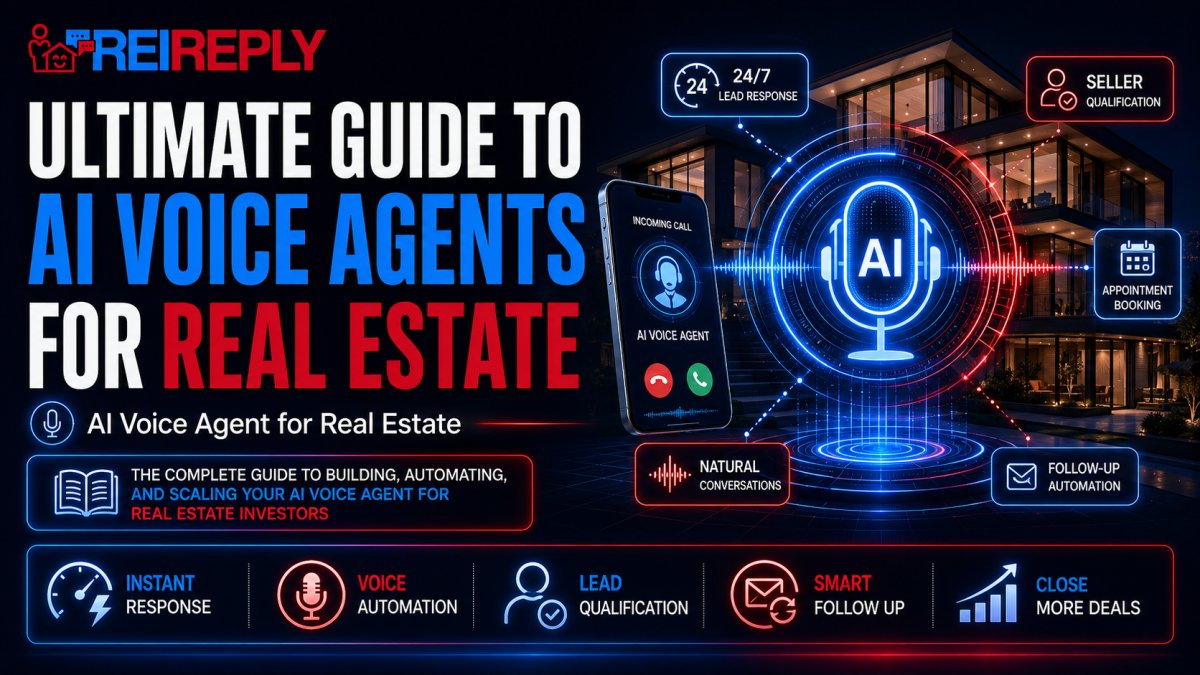
Voice AI for real estate investors is valuable when it supports, rather https://jaideniyda879.iamarrows.com/ai-acquisition-assistant-for-real-estate-investors-from-qualification-to-appointment-booking than imitates, an acquisitions rep. If a system can answer inbound calls, ask baseline qualification questions, and book appointments at any hour, it protects opportunities that would otherwise die in voicemail. For smaller teams, that can be especially important. A solo operator cannot answer every call while driving comps, walking a property, or meeting a contractor.
REI Reply says its AI voice agent can qualify leads, book appointments, and follow up twenty four seven across calls, SMS, email, and socials. Used properly, that kind of AI phone agent real estate workflow can reduce lag and preserve momentum. Used poorly, it can create awkward conversations and low trust. The difference is in scope. Voice automation should capture intent, route the lead, and maintain contact. It should not pretend to be a seasoned negotiator.
That distinction matters in distressed seller leads. If the owner is emotional, confused about title, or worried about timing, a rigid script can do real damage. Human intervention should happen early whenever the conversation moves beyond basic qualification. The best acquisitions teams treat voice AI as a front desk, not a closer.
Compliance is not optional, especially in SMS and calling
A lot of investors treat compliance as a side issue until deliverability drops or a complaint surfaces. That is backwards. If you are using real estate SMS automation, automated text messaging, or AI calling real estate workflows, compliance has to shape the system from the start.
The FTC states that telemarketers must honor Do Not Call rules, may not use the National Registry or entity specific DNC lists for anything other than compliance, and generally may not call outside 8 a.m. To 9 p.m. Local time without prior consent. It also states that prerecorded telemarketing calls require prior signed, written agreement, and that consent can be obtained electronically if E-SIGN requirements are met.
Those rules are not just legal footnotes. They directly affect operational design. If your real estate call automation platform does not account for local time, you create preventable risk. If your staff uses DNC data carelessly, you create preventable risk. If your workflow assumes that all automation is treated the same way, you create preventable risk.
The same discipline applies to business texting compliance. In the U.S., A2P 10DLC is the carrier standard for application to person SMS traffic sent through 10 digit long code numbers, designed to ensure messages are verified and consensual. For investors using bulk SMS real estate campaigns, real estate text message automation, or SMS automation software, A2P 10DLC registration is not an administrative nuisance. It is part of maintaining text message deliverability.
A lot of complaints about SMS carrier filtering are really workflow problems in disguise. Teams blast poor quality lists, send awkward repetitive copy, ignore consent standards, and then blame the channel. Good real estate SMS deliverability usually comes from a mix of compliant setup, sound list hygiene, and better message design.
Why investor specific CRM design matters
A generic CRM can store names and tasks. That is not enough for real estate acquisitions. Investors need a system that behaves like an operating layer for marketing, lead management, and follow up. The best CRM for real estate investors is rarely the one with the most features on a pricing page. It is the one that matches the reality of seller lead generation.
That reality includes duplicate contacts, long sales cycles, multiple channels, and constant handoffs between automation and humans. A motivated seller CRM should let a team see where a lead came from, how many times the owner was contacted, whether there was an inbound call, whether a text was answered, and whether an appointment was set. It should make the real estate sales pipeline visible enough that nobody has to guess which leads are aging out.
REI Reply positions itself exactly in that investor CRM category, rather than as a general business CRM. For teams running real estate wholesaling software stacks, that focus matters. An acquisitions pipeline is not just a contact database. It is a system for managing uncertainty at scale.
One of the biggest mistakes I see is teams buying separate tools for texting, calling, forms, and follow up, then trying to glue everything together with spreadsheets. It works for a month or two. Then attribution gets fuzzy, tasks get missed, and the same owner gets contacted from multiple numbers with different messages. A unified real estate AI CRM can reduce that chaos, provided the business also commits to process discipline.

Data plus automation only works if the handoff is clean
Verified motivated seller data can improve the top of the funnel. Real estate automation software can improve speed and consistency. But neither solves the human bottleneck if the handoff from machine to acquisitions manager is vague.
When a lead becomes genuinely active, the next move has to be obvious. Who owns the conversation? What counts as qualified? What happens after an appointment is booked? How long does the system wait before reengaging a no show or unresponsive seller?
These are not software questions alone. They are management questions. AI lead qualification can narrow the field, but someone still has to define qualification. AI follow up can keep the conversation alive, but someone still has to decide when a seller is warm enough for direct negotiation. Real estate investor automation sharpens execution only when the business has standards.
A practical setup often looks less glamorous than people expect. Verified motivated seller data enters the CRM. Initial outreach happens through compliant SMS and calling workflows. Responses are captured in one record. Simple qualification can be handled by automation. Appointment ready leads are routed to a human. Long term nurture continues until timing changes. None of that is flashy. All of it makes money.
Where REI Reply fits, and where judgment still matters
REI Reply appears to sit at the intersection of real estate lead management, follow up automation, and investor specific CRM functionality. Its own positioning emphasizes conversion rather than promising that software alone will create deals. That is the right frame. A platform can accelerate lead response, keep seller conversations organized, support AI lead follow up, and provide access to verified motivated seller data through REI AI Leads. It cannot substitute for market judgment, pricing discipline, or negotiation skill.
For wholesalers, fix and flippers, buy and hold operators, and acquisitions teams, that distinction is healthy. Software should remove friction. It should not encourage lazy underwriting or careless outreach. The best results usually come from teams that treat automation as leverage, not as a shortcut.
If you are evaluating AI tools for real estate investors, the useful questions are practical. Does the system fit how your leads actually arrive? Can it support seller lead follow up across calls and text without fragmenting the record? Does it help your team respond faster? Does it improve compliance discipline rather than making it easier to ignore? And if it includes access to motivated seller data, can your team actually work that data with consistency?
Those are the questions that matter because deals are won in the ordinary moments. The missed call that gets a fast reply. The text that lands cleanly instead of getting filtered. The seller who was not ready last month but responds on the seventh follow up. The appointment that gets booked at 9:12 p.m. Because someone, or something, was still there to answer.
That is the real promise of AI real estate leads systems when they are built well. Not magic. Not hype. Just a tighter path from verified data to real conversations, and from real conversations to signed contracts.